998 (90) 174-57-84


Laboratory method for determining COD using a spectrophotometer
- The essence of COD analysis using a spectrophotometer.
- Necessary instruments and reagents for the determination of COD in the laboratory
- General recommendations for analysis
The essence of COD analysis using a spectrophotometer
Chemical oxygen demand (COD) analysis is a procedure for determining the amount of oxygen consumed for the oxidation of all organic and inorganic substances that are contained in drinking, waste or process water.
 The most common laboratory method for determining COD is colorimetric, which usually uses potassium dichromate as an oxidizing agent. The compound is a bright orange hexavalent chromium salt and has strong oxidizing properties, oxidizing from 95 to 100% of inorganic and organic compounds in the analyzed sample. After oxidation, the dichromate converts to the trivalent form of chromium, which is dull green in color.
The use of a spectrophotometer as an instrument for COD analysis involves measuring the consumption of dichromate during the oxidation process. There are two approaches, both widely used to determine COD values in a water sample:
- Trivalent chromium is determined after analysis at a wavelength of 600 nm.
- Hexavalent chromium can also be measured at 420 nm. to determine excess chromium, which will also determine the COD value.
In fact, when using a spectrophotometer for COD analysis, either the concentration of oxidation products (Cr3+) is measured, which is then converted to the COD value, or the remaining non-oxidized starting substances (Cr6+) are measured, which are also converted to the COD value.
Necessary instruments and reagents for measuring COD in the laboratory
Proper COD analysis is important in determining the effectiveness of water treatment and can help identify any problems in the process. So, what is needed to obtain accurate and reliable results?

Reagents
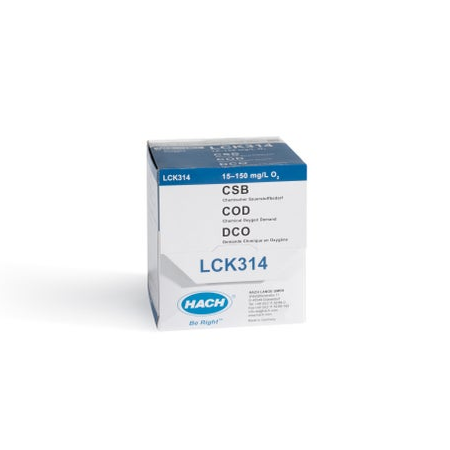
 Reagents are one of the key components in COD testing. They are responsible for the oxidation of organic substances in the sample. Reagents can be prepared on your own, but it is easier to purchase them to minimize contact with chromium and acids. Usually, these are hermetically sealed cuvettes, ready for use, with premixed reagents necessary for analysis.
For COD measurements on a spectrophotometer, Hach's ready-to-use LCK cuvette tests are best suited. As described above, the essence of the analysis is reduced to the oxidation of organic and inorganic compounds in the sample with potassium dichromate in an acidic medium, after which the green color of Cr3+ is being assessed photometrically.
Chlorides contained in the sample are the main interference and can affect the result. LCK reagents for the determination of COD by the dichromate method contain mercury sulfate, which eliminates this influence. If no or very low chloride concentrations are expected in the sample, a mercury-free tests can be selected to reduce the risks associated with handling mercury.
Thermostat (heating block)
 The methods described for COD analysis require a sample heating step (148 °C), because oxidation in COD analysis occurs only at high temperatures. Thus the thermostat (heating block) plays an essential role in ensuring accurate results. For best results, choose a device with multiple temperature settings so you can use it for other tests such as total phosphorus, nitrogen, or iron. Most thermoreactors are equipped with a timer for setting the exact time for the duration of heating. For additional safety, the devices are equipped with a cover that covers the heating block.
Any LT200 or HT200S will work. The advantage of the LT200 model is the ability to run two programs in parallel, due to the possibility of ordering it with two installed heating blocks. In turn, the HT200S is high-speed and can complete the task in just 35 minutes.
Spectrophotometer
 The advantage of using Hach spectrophotometers is that they have pre-programmed measurement methods, which allows you to analyze as accurately and quickly as possible, without the need to build additional calibration curves.
Hach offers a fully matched system of spectrophotometer, reagents and methods designed to optimize your analysis process. When using the LCK series of cuvette tests, the spectrophotometers automatically determine the method and provide excellent accuracy.
General recommendations for perfoming COD test
- It is not recommended to start analysis on a spectrophotometer until the cuvettes removed from the thermoreactor have cooled down to room temperature. The measurement may not be accurate and the hot reagent cell may damage the digital instrument.
- A common mistake when performing the test is the step of inverting the cuvette. After the digestion of the sample in the thermoreactor and until the cuvette is completely cooled, it must be turned over several times. This will return the condensate that has collected on the walls to the reacted sample. Do not invert the cuvette just before inserting it into the spectrophotometer. It is necessary to give time for undissolved particles to settle to the bottom and go beyond the path of the light beam of the measuring device.
AquaAnalytics® is the official representative of Hach in Russia and CIS countries. Contact us in a convenient for you way and our specialists will consult and select the necessary reagents and instruments for the analysis of chemical oxygen demand in your laboratory, taking into account the specifics of the analyzed samples.
Representative office in Russia: +7 (495) 201-53-02 info@aquaanalytics.ru
Representative office in Uzbekistan: +998 (90) 174-57-84 info@aquaanalytics-tekhnika.ru